
A normal website can expose more than its content. Its IP address, hosting region, web stack, and traffic patterns can all become part of the public record. Tor onion services use onion routing, keeping traffic inside the Tor network rather than sending visitors through an exit relay. This helps hide the server’s network location.
Once called hidden services, these services can protect journalists, researchers, support organizations, and security teams. That privacy isn’t a magic cloak. Tor doesn’t make an unsafe application, careless administrator, or weak password anonymous or secure.
The first step is understanding what an onion service hides, and what it does not. It reduces direct server-location exposure, but traffic correlation by a global observer can still reveal relationships between users and services.
Key Takeaways
- Tor onion services hide a server’s public network location by keeping traffic inside the Tor network, but they do not make insecure applications, weak passwords, or careless administration safe.
- Modern v3 onion addresses are tied to cryptographic keys, so operators should publish them through trusted channels and treat unexpected address changes as possible impersonation attempts.
- Safe hosting requires a private backend, separated system roles, protected service keys, limited logs, careful review of outbound connections, and tested recovery plans.
- Client authorization, sensible access controls, rate limits, proof-of-work defenses, and monitoring can reduce unauthorized access and denial-of-service impact.
- An onion URL is not proof that a site is legitimate. Verify addresses independently, avoid entering credentials or downloading files until the destination is trusted, and remember that privacy does not guarantee availability.
How Tor onion services work
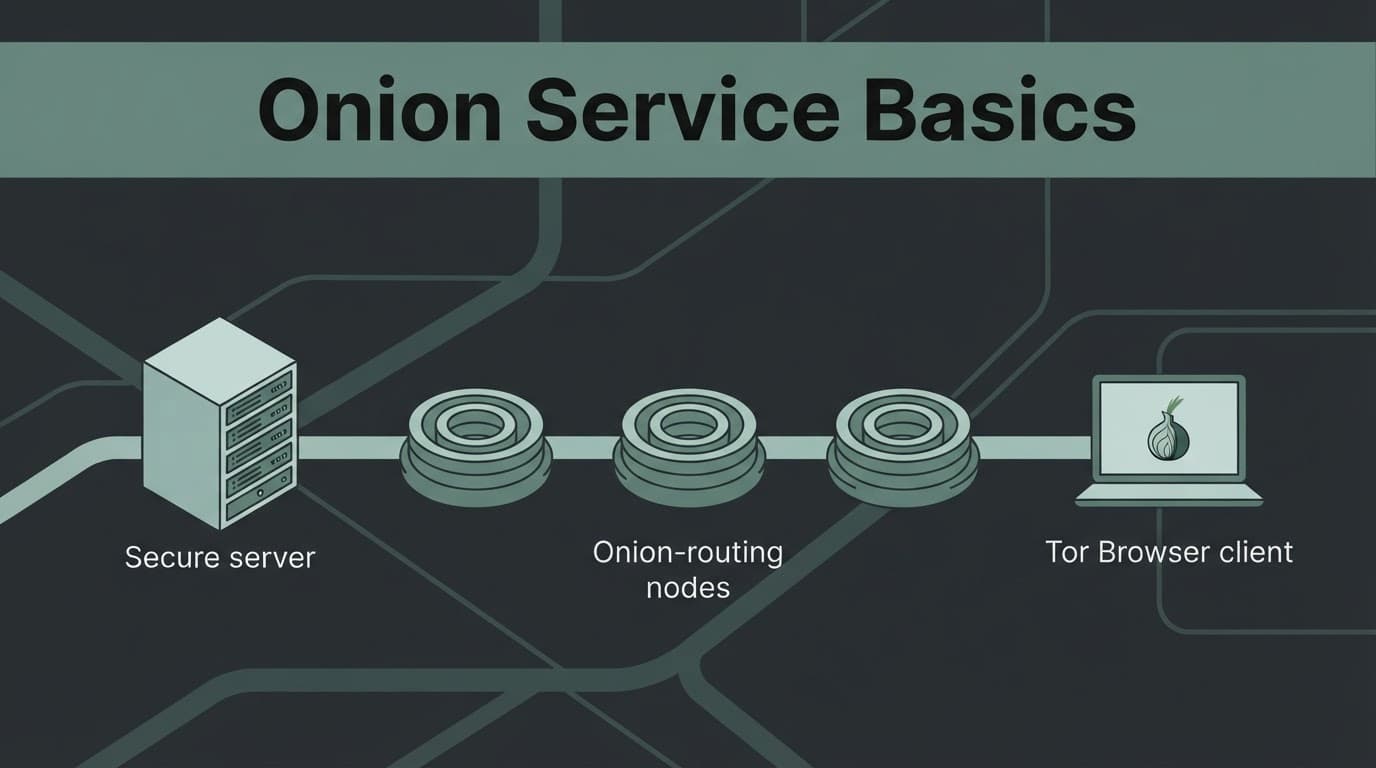
These services are websites or network services reachable only through the Tor network. Visitors use Tor Browser and a .onion address instead of a regular domain and public DNS record. Traffic stays inside onion routing, so it doesn’t pass through an exit relay.
Unlike a clearnet site, an onion service has no public-facing IP address for a visitor to query. A clearnet site can advertise its onion equivalent with Onion-Location, a discovery mechanism rather than an additional routing layer.
A v3 onion address is also an identity
Modern onion sites use v3 addresses. These are 56 characters followed by .onion, and the long address isn’t random decoration. It’s tied to the service’s public cryptographic key.
That design helps Tor Browser verify the signed service descriptor before connecting. The Tor Project’s onion service overview explains how this descriptor contains the service’s designated contact relays and authentication material.
A v3 address can be difficult to share, but it has one clear security advantage. If an attacker replaces a familiar-looking web address, the real onion address won’t match. Publish it through trusted channels, keep it consistent, and treat a sudden address change as a serious event.
Introduction points and rendezvous points keep both sides private
The service first creates circuits to each introduction point, maintaining several connections for resilience. It then publishes those points in its signed descriptor through Tor’s distributed hash table.
When a visitor enters the address, the client retrieves that descriptor from the distributed hash table and chooses a rendezvous point. The visitor sends a one-time secret through an introduction point. At the introduction point, the onion service receives it, builds its own circuit to the rendezvous point, and proves it knows the same secret.
That circuit creation joins two separate three-hop circuits, one from the visitor and one from the service. The rendezvous relay forwards encrypted traffic between them, but it shouldn’t learn either side’s IP address or read the content.
Where onion hosting is useful, and where it isn’t
An onion service is useful when a public server location creates unnecessary risk. A news organization may use a secure drop for sensitive tips when its application and practices protect sources. A human-rights group may publish information without forcing visitors onto a monitored local network.
Tor is also useful for internal portals, incident reporting, and private support services. It gives users a safer route to reach a service when ordinary access is blocked or watched.
Legitimate privacy has many uses
Most deep web sites are not onion services. A company intranet, patient portal, or subscription database is part of the deep web because search engines cannot index it. The historical term hidden services referred to onion services, but non-indexed sites aren’t automatically Tor services.
The Tor Project’s overview of onion service properties explains why onion services avoid the normal Tor exit node model, reducing exposure for users and operators. An organization’s official clearnet site may publish an Onion-Location header for its service.
Still, an onion URL does not establish a site’s purpose. Search results often place research resources beside a darknet market. Those categories should never be treated as equal. Privacy tools have lawful uses, while illegal sales, fraud, malware distribution, and stolen data cause real harm.
An onion URL is not a trust mark
There is no central registry of verified Tor websites. A copied onion address, fake directory, or typo can send a visitor to an impersonator.
Names such as Tor Taxi or Tor Watch may appear in discussions of onion directories, but directory listings can move, disappear, or be copied. Check addresses against an organization’s public clearnet site, official social channels, or another source you already trust. If its Onion-Location value is unexpected or changed, verify it before proceeding.
“Verified onion links” should mean independently checked, not blindly accepted. For research and educational context, Verified Tor Onion Links is one resource readers may choose to review. Confirm the destination independently before opening it in Tor Browser. Don’t enter credentials or download files until that check is complete.
Host an onion service without exposing your server
A safe deployment starts with separation. Your Tor process, web application, database, administrator accounts, and public communications shouldn’t all sit in one exposed place.
Onion routing hides the route to a service. It can’t hide information your own server, plugins, analytics scripts, or staff accounts leak. Logs, error pages, or application behavior can still reveal an IP address or other network information.

Keep the backend private
Build these controls into your server configuration. Bind the application to localhost or a Unix socket where possible. Use firewall rules to block public inbound access to the backend port.
The server should accept web requests from the local Tor service, not from the open internet. Don’t run a Tor relay on the same machine as a sensitive onion service. Separate roles limit what one compromise can reveal.
Use separate accounts for deployment and administration. Avoid reusing email addresses, usernames, payment records, or SSH keys connected to your personal identity. Review outbound connections, including remote analytics, third-party fonts, embedded media, update checks, and error-reporting tools. These calls can create observable patterns for traffic correlation and records you didn’t plan to share.
If you operate a clearnet site, audit whether its configuration intentionally advertises the onion site through Onion-Location. Even with a private backend, location privacy doesn’t replace availability protection against a denial of service.
Protect keys, logs, and recovery plans
The service private key controls the address. Back it up in encrypted offline storage separate from the host. Restrict file permissions, and never place the key in a public code repository or ordinary cloud folder.
The Tor process handles descriptor publication through the distributed hash table. Keep its data directory separate from application files, with restrictive permissions.
If the key is lost, the service address is lost too. Visitors can’t follow an old address to a replacement site. Test restoration before an outage forces you to learn this lesson.
Keep logs short and useful. Record uptime, errors, and system health without collecting more visitor data than your service needs. If you suspect an IP leak or application exposure, stop guessing. Use your in-house team or an authorized assessment with written scope, such as Pro Ethical Hackers For Hire.
Tor can hide a server’s location, but it can’t protect a weak application. An unpatched CMS, plugin, exposed admin panel, or reused identity can create a vulnerability that exposes its operator.
Access control, TLS, and abuse prevention
Public access is not always the right choice. A staff portal, source-submission system, or partner dashboard needs access limits before it needs more traffic.
Control access and make sensible TLS choices
Tor’s client authorization feature lets an operator require a credential before a client can reach the service. Only users with the correct token can connect. The official client authorization guidance is useful when setting up private services for staff or trusted partners.
Give each person or team separate credentials. Individual client authorization credentials make revocation possible when a device is lost or a role changes. Shared access keys are easy to distribute and hard to control.
TLS isn’t required for Tor’s encrypted connection path. An onion-only site can use Tor’s end-to-end protection without a public certificate authority. An SSL certificate can still support application compatibility, HTTPS-only policies, or defense in depth. It doesn’t fix insecure code or weak access control.
Plan for denial of service attempts
An attempt at denial of service may target an introduction point or fill the request queue around rendezvous circuits. Denial of service pressure can overload an introduction point, exhaust connection capacity, and make normal visitors wait. Treat denial of service as an operational event, not only a traffic spike.
These attacks can cause resource exhaustion when connection capacity is consumed. They differ from broad network congestion, which can affect users even when the service is healthy.
Tor provides rate limits and optional proof of work defenses. With that defense enabled, clients solve a small puzzle before the service accepts a rendezvous circuit. This adds cost during circuit creation and can slow abusive clients. Tor’s onion service DoS guidelines document available controls, including queue settings and defenses for each introduction point.
The 2025 Onions Got Puzzled research paper described onionflation attacks that manipulate client puzzles. That onionflation pattern can drive puzzle difficulty upward and block legitimate users.
Set a baseline puzzle difficulty for expected traffic and available capacity. That puzzle difficulty creates a measurable client cost, so keep it manageable for legitimate users. Adaptive controls may raise puzzle difficulty as abusive traffic increases. Rising queue pressure can raise puzzle difficulty before connections fail.
Measure puzzle difficulty against traffic reaching each introduction point. Higher puzzle difficulty can add latency for legitimate users.
Set request queue limits and cap puzzle difficulty below a tested ceiling. Monitor puzzle difficulty with failed connections and request queue depth. Test the proof of work configuration under expected traffic, recording puzzle difficulty at each traffic level.
Monitor availability and respond with care
A service can be online while users still cannot reach it. Check it from an independent Tor Browser session, not only from the server itself. Monitor response time, error rates, disk space, request queue, Tor process health, and circuit creation. Compare puzzle difficulty with a normal baseline, then review server configuration files and settings, including unexpected changes to an Onion-Location advertisement or header.
Watch for changes that don’t fit normal traffic
Compare failed requests, CPU use, queue pressure, and repeated circuit failures; check whether an introduction point is responding and record descriptor failures. Measure legitimate-user completion against puzzle difficulty, then compare accepted and rejected requests as puzzle difficulty changes. Set alerts against normal puzzle difficulty; repeated introduction point failures or circuit problems may signal onionflation or a denial of service.
Keep an alert path that doesn’t depend on the affected service, and watch for unusual puzzle difficulty during peak periods. A separate email account, status page, or internal messaging channel helps your team respond without using the failing system.
Keep incident steps short and clear
Write down who can restart the service, restore a private key, revoke authorization credentials, and test recovery. Escalate a suspected denial of service through the independent alert path, and preserve only evidence needed for diagnosis and legal obligations.
After enabling the challenge, review proof of work logs and client-failure metrics; compare those results with puzzle difficulty before changing controls. Confirm normal access after recovery. Validate puzzle difficulty with normal clients, and document the result. Record any remaining failures before closing recovery. Review onionflation trends in the incident record before tuning puzzle difficulty against the original baseline.
Patch Tor, the operating system, and the web application on a planned schedule. Follow relevant security advisory guidance from Tor, operating-system, and application maintainers. Security is not one setting. It is the repeated habit of reducing exposure before it becomes an incident.
Frequently Asked Questions
What is a Tor onion service?
A Tor onion service is a website or network service reachable through the Tor network using a .onion address. Its design hides the service’s public IP address and keeps connections inside onion routing rather than sending visitors through an exit relay.
Does a Tor onion service make a website completely anonymous and secure?
No. Tor can reduce direct server-location exposure, but it cannot protect an unpatched application, weak credentials, exposed administration panel, or reused identity. A global observer may also perform traffic correlation, and application behavior or outbound connections can reveal information.
How can I verify that an onion address is legitimate?
Compare the address with the organization’s official clearnet website, verified social channels, or another trusted source. Because there is no central registry of verified onion websites, do not rely on copied directories or familiar-looking names, and avoid entering credentials until the destination is independently confirmed.
What are the most important steps for hosting an onion service safely?
Keep the backend private by binding it to localhost or a Unix socket, blocking public inbound access, and separating Tor, application, database, and administration roles. Protect the service’s private key with encrypted offline backups, use access controls where appropriate, limit sensitive logs, and test restoration before an outage.
How can operators respond to denial-of-service attempts?
Monitor queue depth, circuit failures, introduction points, resource use, response times, and proof-of-work difficulty from an independent monitoring path. Configure rate limits, queue limits, and proof-of-work defenses within tested ceilings, then use a documented incident plan to preserve necessary evidence, recover access, and validate normal clients.
Final Thoughts
Onion services can give a website a private onion address, encrypted Tor routing, and stronger protection against location exposure. Those benefits matter most when the server, users, or published information face real risk.
The strongest setup combines Tor with isolated hosting, private key backups, careful access control, and active monitoring. It doesn’t guarantee availability or prevent denial of service. Privacy works best when every layer is treated as part of security.