
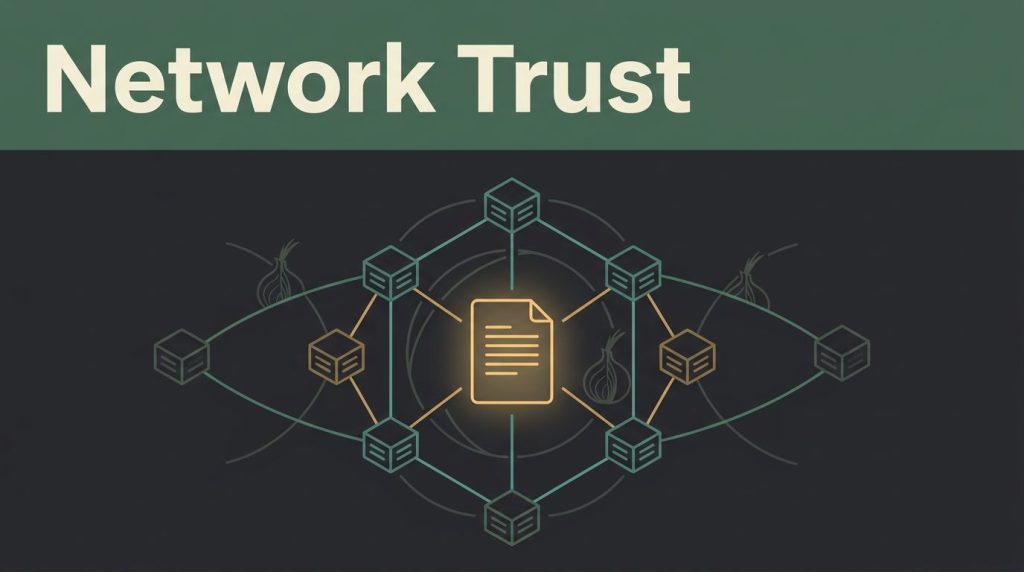
Tor is an anonymity network that depends on onion routing and a consistent relay view. Before Tor Browser picks a guard relay or an exit node, it relies on a shared view maintained by Tor directory authorities.
That shared map helps clients locate recognized relays and onion services across the Tor network. A directory authority contributes to this view through the signed consensus document, but inclusion or reachability doesn’t prove a website, seller, or service operator is honest or safe.
Knowing where that trust stops is part of using Tor with care.
Key Takeaways
- Tor directory authorities maintain a shared, signed consensus that gives clients a consistent view of recognized relays and their network roles.
- Known authority identities, long-term keys, rotating signing keys, and majority signatures help clients verify that a consensus came from the expected participants.
- With nine voting authorities, at least five must sign the same consensus before a client accepts it as valid.
- A relay’s consensus status, bandwidth measurement, Guard or Exit flag, and an onion service’s reachability do not prove that an operator, website, or service is safe or legitimate.
- The trust model can still be affected by outages, compromised authorities, coercion, protocol vulnerabilities, and attacks that provide inconsistent network views.
Trust Starts With Known Authority Identities
The Tor Project’s official glossary lists nine voting authorities, operated by trusted individuals. Each directory authority is a specialized, preconfigured server, not a public group that any relay operator can join.
Tor clients store authority fingerprints and directory endpoints, giving onion routing in the Tor network a common trust anchor. They recognize a directory authority by its configured identity, not by an arbitrary server’s claim or familiar nickname. Authority signatures identify the directory participant, but don’t authenticate onion services or their operators; they also don’t authenticate content from those onion services.
Root keys and rotating signing keys
Each authority relies on long-term identity keys and a medium-term signing key. The long-term keys are deeper trust anchors. They’re kept offline when possible rather than exposed on a server every day.
The online signing key uses cryptographic signing for votes and consensus data. A certificate links the signing key to the long-term key, letting clients verify the active key’s authority. Tor’s directory protocol outline describes this separation between the authority’s long-term identity and its rotatable signing key.
Key rotation limits damage when an online signing key is exposed by a compromised authority. It doesn’t eliminate compromise risk, but it adds a clear verification step before a client accepts a signature.
Why independent operators matter
Separate authority operators create distributed trust. No single authority should be able to decide which relays all Tor users see.
That is why uptime, careful administration, fast response times, and independent hosting matter. If one authority is offline, hacked, or pressured, the others can still help produce a valid network view.
This is not a trustless system. It spreads trust across several fixed identities and requires a majority before clients accept a new consensus.
How Tor directory authorities create consensus
The consensus cycle normally runs hourly. In this consensus protocol, the Tor network collects relay information, and each directory authority prepares a signed vote. Every directory authority compares the submitted votes before all authorities sign one common result.
Relay descriptors, flags, and bandwidth data
Every Tor relay publishes signed relay descriptors containing technical details such as relay keys, addresses, ports, policies, and supported capabilities. Authorities review these records and use network observations to assess current relay behavior.
Their votes include network status information, such as whether a relay is running, valid, fast, stable, a possible guard relay, or an exit node. These flags influence path selection, but Guard and Exit eligibility are not moral judgments about a relay. Clients use the shared relay map to build paths toward onion services. Relay eligibility doesn’t validate the operators or content of onion services.
Measured bandwidth affects relay weighting. A bandwidth authority provides data on a relay’s measured network capacity, so a relay can’t simply claim high speed and receive more traffic. These measurements influence network parameters and help show network health, but bandwidth is not a character reference.
Tor’s process seeks agreement among known participants, while a general Byzantine Broadcast primitive describes a broader agreement problem. This comparison doesn’t mean Tor implements that primitive as a generic component.
Authorities can exclude bad relays that fail checks or don’t meet protocol requirements. They can’t reliably detect every malicious relay, especially one that behaves normally while collecting limited observations for traffic analysis.
One document, many signatures
After votes are exchanged, authorities apply common rules to calculate a single consensus document. The Tor consensus format specified by the Tor Project defines the authority entries, relay entries, timestamps, and signature fields in that document.
The resulting document must be byte-for-byte identical before several authorities can countersign it. The Tor consensus computation rules explain how authorities combine votes into this shared result.
That result gives the Tor network a consistent relay view for onion routing. A signature authenticates that exact file and shows that a known authority approved it. It says nothing about the character of a relay or service.
What Tor Clients Verify Before Use
A consensus document contains validity windows and presents one current network status view. The valid-after field marks when the relay map becomes active, fresh-until tells the client when to refresh, and valid-until marks when the map is too old to trust.
The majority signature threshold
Clients in the Tor network compare consensus signatures with their preconfigured authority identities. Before using onion routing to construct paths, they check the signatures and timing fields.
If a consensus references an unfamiliar signing key, the client can obtain its matching certificate and validate it against a recognized directory authority’s long-term identity key.
The client accepts a consensus only when more than half of its recognized authorities have signed the same document. With nine authorities, at least five signatures are needed.
This is the quorum rule. It prevents a lone authority, or a small group, from replacing the network map with its own version. These checks also protect the relay-selection layer used by onion routing.
A majority signature proves that enough predefined authorities approved one relay view. It doesn’t authenticate onion services or prove that their owners, content, or offers are safe.
What users gain, and what they do not
Most clients download consensus data through directory caches rather than connecting directly to every authority. That makes distribution faster and reduces reliance on one server.
The consensus gives your client a current relay list and weights for path selection. Those weights help it choose a guard relay for entry, an exit node for web traffic, or relays used to reach onion services. Clients can reach onion services through the relay map, but the signatures provide no guarantee about their content or ownership.
The consensus doesn’t protect you from logging into an identifiable account, downloading unsafe files, exposing personal details, or all forms of traffic analysis. Recognizing an exit node also doesn’t certify that its operator is trustworthy.
Tor improves privacy at the network layer as an anonymity network, but it doesn’t replace safe browsing habits. Those habits still matter at every step.
Directory Authorities Are Not Onion Service Directories
Several Tor components have similar names, but they support separate directory roles in onion routing.
Three roles that should not be confused
| Component | Main job | What it does not prove |
|---|---|---|
| directory authority | Votes on and signs the public relay consensus | That every relay is harmless |
| Ordinary relay | Carries Tor traffic and may cache directory documents | That it can define network-wide relay status |
| Onion service directory, or HSDir | Stores encrypted descriptors for onion services | That an onion service belongs to a legitimate person or group |
An HSDir helps a Tor client locate onion services. It doesn’t review onion services or verify the identity behind them. HSDirs also don’t vote on the public relay consensus for the Tor network.
Older Tor material may mention Tonga. It was a bridge authority, not a normal voting authority. Bridge authorities process information about bridge relays for BridgeDB and don’t vote in the public consensus. Tor later replaced Tonga with Bifrost as the bridge authority handling bridge relays.
A valid consensus is not a safe-link label
Many pages promote Verified onion links, verified Tor websites, deep web sites, Tor Watch feeds, or a Tor Taxi-style index. Those labels aren’t granted by the Tor consensus, and onion routing doesn’t verify website operators.
A consensus can identify an exit node’s routing role, but it doesn’t make that relay trustworthy.
The same warning applies to deep web market places. A working .onion address only shows that a service can be reached. Neither it nor a directory listing establishes who operates onion services or whether they’re legitimate, safe, or legal.
For lawful research, treat Verified Tor Onion Links as an untrusted reference only, and compare addresses with an organization’s official channels. Never send money, enter credentials, or download files because a directory description sounds convincing.
Where the Trust Model Can Fail
The majority rule reduces risk, but it doesn’t make the Tor network immune to outages, coercion, or a security vulnerability in the protocol.
If five authorities are seized or unavailable
If five of nine authorities become unavailable, the remaining votes can’t create a fresh consensus with a majority of signatures. Each directory authority contributes a vote to that quorum. Clients may continue using their last valid consensus for a limited time, but they can’t safely rely on an outdated relay map forever.
A server seizure doesn’t automatically reveal protected offline identity material. Long-term signing keys are designed to remain offline. Control of enough active signing keys is a different threat.
One compromised authority isn’t enough to create a majority. The active signing keys of five authorities could form a majority. An attacker with that level of control could cause a directory authority to approve a harmful relay view.
That wouldn’t automatically expose every Tor user’s traffic. It could make onion routing path selection less trustworthy around a chosen exit node, increasing targeted traffic analysis.
A harmful view could affect access to some onion services, but it wouldn’t authenticate onion services or their operators.
Equivocation is a separate concern
A 2025 paper, “Attacking and Improving the Tor Directory Protocol,” describes an equivocation attack. It could undermine onion routing by giving a targeted client a different, valid-looking network view. Other clients might receive the normal view.
That matters because a majority threshold mainly protects against obvious minority votes. It doesn’t solve delivery consistency, so inconsistent views could facilitate targeted traffic analysis.
Public, append-only records could help expose conflicting consensus views. The Tor Project’s consensus-transparency proposal outlines one way to make consensus and vote records easier to verify later. This remains a research proposal, not a deployed guarantee. Research tools such as TorEq also focus on detecting suspicious consensus differences.
If you operate onion services or relay infrastructure, any security assessment should be documented and authorized. Any testing provider, including Pro Ethical Hackers For Hire, should be engaged only for systems you own or administer, with written permission from the relevant owner.
Frequently Asked Questions
What does a Tor directory authority do?
A directory authority reviews relay information, prepares a signed vote, and helps produce the shared Tor consensus. That consensus gives clients the relay map used for onion routing and path selection.
How many authority signatures are needed for a Tor consensus?
Tor clients require more than half of their recognized authorities to sign the same consensus. With nine voting authorities, at least five matching signatures are needed.
Does a valid Tor consensus prove that an onion service is safe?
No. A consensus can help a client locate relays and reach onion services, but it does not authenticate an onion service, its operator, its content, or its offers.
Is an Exit flag an endorsement of a relay operator?
No. The Exit flag describes a relay’s network role and eligibility for carrying traffic toward the public internet. It is not a character reference or a guarantee that the operator is trustworthy.
What happens if several directory authorities become unavailable?
If enough authorities are unavailable, the remaining authorities may not be able to produce a fresh consensus with a majority of signatures. Clients can use a last valid consensus for a limited time, but an outdated relay map cannot be trusted indefinitely.
Final Thoughts
The consensus is the Tor network’s shared road map for onion routing, not a stamp of approval for relays, websites, or onion services. Known authority identities and certified signing keys enable majority signatures. A directory authority uses them to establish a network view, not approve a website, service, or operator.
Selecting an exit node is a network-validity decision, not a safety endorsement; paths may still lead to onion services. Onion routing supports privacy within an anonymity network, but it doesn’t verify onion services or prevent traffic analysis.