
Tor is strongest when no small group of networks gets to see too much of the same traffic. That’s why Tor relay diversity matters to people using Tor Browser, public websites, and onion services.
This design doesn’t promise end-to-end anonymity. It uses onion routing within an anonymity network to reduce avoidable concentration, making one operator, country, hosting company, or internet network less likely to become a common observation point. It also can’t prevent endpoint or browser mistakes from exposing your IP address.
As Tor’s technical introduction makes clear, the Tor network is a distributed system for anonymizing low-delay TCP traffic. It’s not an invisibility tool.
That distinction matters when your privacy, research, identity, or sensitive communications are on the line.
Why Tor relay diversity matters for user anonymity
The Tor network uses onion routing to wrap data packets in layers. Circuit selection builds a route through several relays before traffic reaches the open web. Each relay sees only part of it, but protection weakens when paths depend on one company, jurisdiction, or network owner.
Three hops reduce single-point exposure
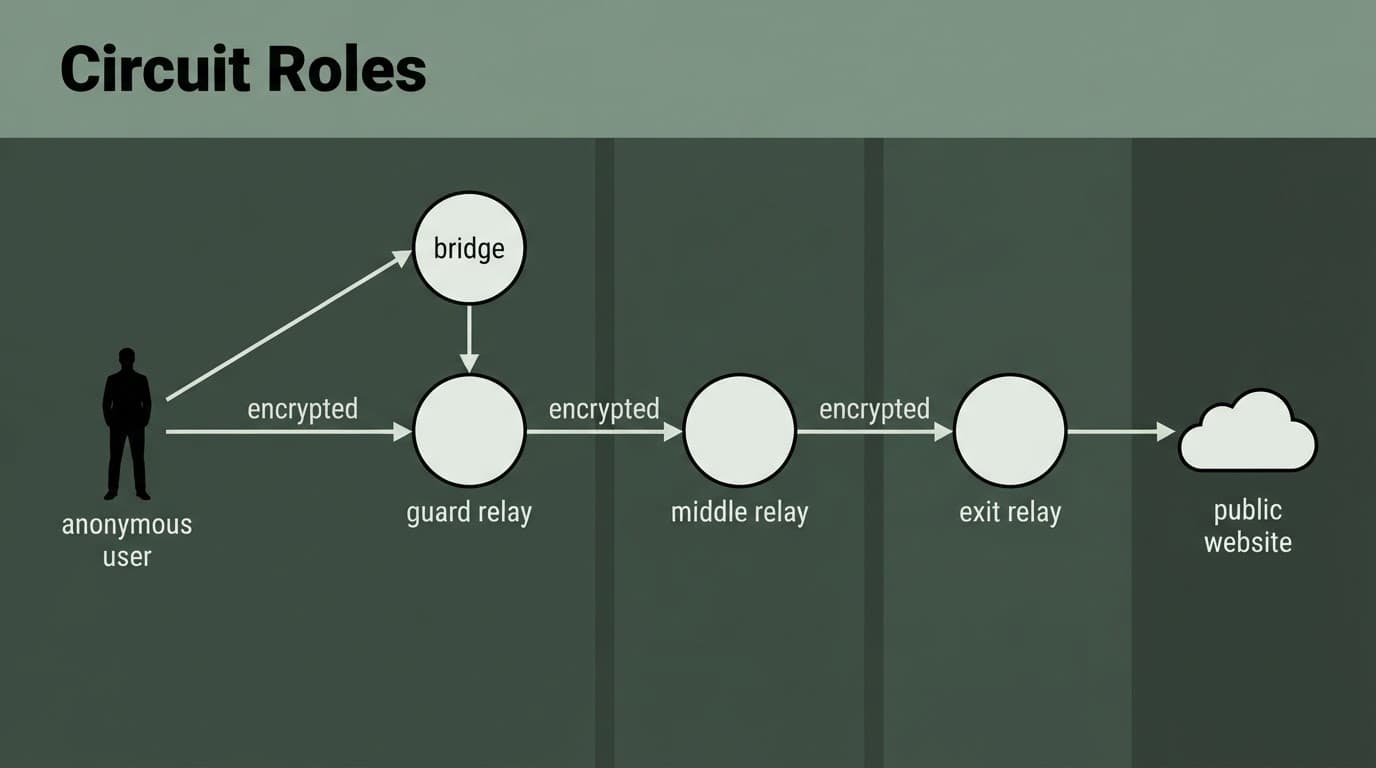
For ordinary web browsing, the Tor browser commonly uses three relays: a guard relay, a middle relay, and an exit relay. The guard sees your IP address, not the final website; the exit can reach it, but shouldn’t know who started the connection.
The middle relay sits between them. It helps separate the two ends of the connection.
No single relay should see both your identity and destination. Circuit selection helps preserve that separation, though longer paths can increase latency. This is why Tor doesn’t work like a basic VPN, where one provider handles the full route.
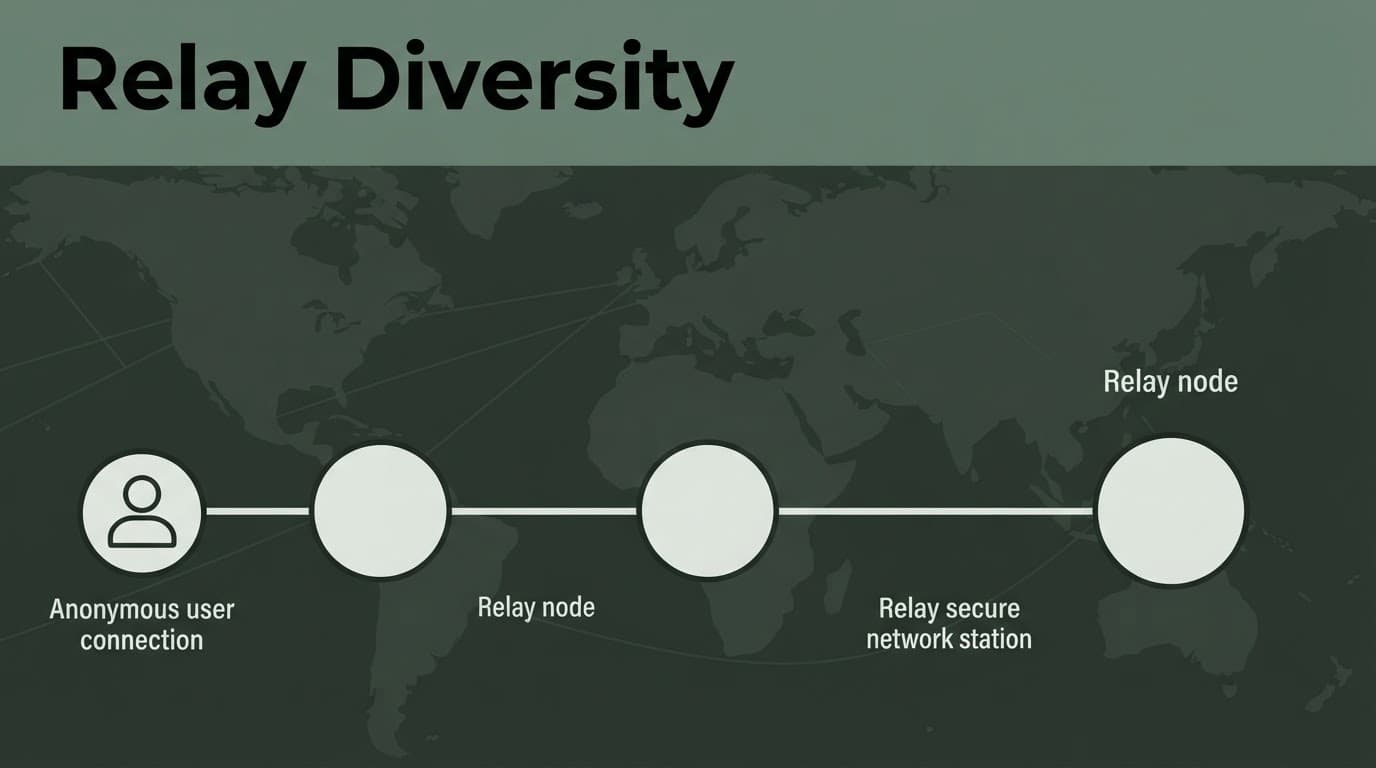
Three relays in three countries can still share one provider or autonomous system. A country view alone can hide the more important connection.
Diversity is more than different countries
Geographical diversity matters, but it is only one part of the picture. A healthy Tor network also needs diversity among relay operators and hosting providers, along with operating system diversity.
An AS is a large network managed by one organization, such as an ISP, cloud provider, or telecom company. If traffic repeatedly crosses the same AS, that network may observe patterns even when relays are hosted in different countries.
During circuit selection, Tor separates relay families, uses AS information, and applies capacity-based consensus weight to support path independence. A relay family usually means the relays are controlled by the same operator. This reduces the chance that one person or group controls multiple positions.
Guard, middle, and exit relays have separate jobs
The relay role matters as much as its location. In the Tor network, onion routing splits knowledge across separate roles. Circuit selection assigns those roles instead of giving one server the full route.
Guard relays are closest to your connection
Your guard relay is the first public relay your Tor browser contacts. Tor keeps a small set of guards for longer periods instead of selecting a new first hop for every circuit.
Circuit selection uses that persistence to limit repeated exposure to random first relays. If a user picked a new guard every time, the odds of eventually selecting a hostile one would increase. The Tor guard specification explains how guard selection reduces that risk.
Guards are chosen from relays that meet Tor’s requirements, and their consensus weight, based largely on measured bandwidth, influences selection frequency. High capacity supports usability, but it can also concentrate traffic among a small group of powerful relays.
Middle and exit relays complete the circuit
The middle relay forwards encrypted data packets between the guard and the exit. It doesn’t have a complete view of either endpoint, so it can’t link the user’s IP address to the final destination. Its main job is to keep the circuit separated.
An exit relay is the final step for normal websites. The multi-hop route adds latency compared with a direct connection. Circuit selection uses its exit policy to constrain which destinations or services the route can reach.
The exit can see traffic leaving Tor. That’s why HTTPS still matters. A secure HTTPS connection protects content between your browser and the website, even when the exit handles the last hop. Never treat Tor as a replacement for encryption.
Concentrated relay bandwidth creates real privacy risks
Germany, the United States, France, and a few other countries have long hosted a large share of the Tor network’s relay capacity. There are practical reasons for this. These regions often have reliable hosting, strong connectivity, affordable bandwidth, and established volunteer relays and operators.
Still, concentration creates risk. If relay capacity piles up in a small number of networks, users have fewer independent paths for circuit selection.
Country diversity is only the first check
A relay in Brazil and a relay in the Netherlands may appear to provide geographical diversity on a map. Yet both could use the same autonomous system, global cloud provider, or upstream carrier.
This is why Tor researchers measure relay distribution by country and AS, not only by raw relay counts. These measures show whether circuit selection provides genuinely independent routes. The Tor Project’s network safety research discusses why AS diversity matters when evaluating real anonymity risks.
A more distributed Tor network gives attackers fewer easy observation points. It also helps users in regions where few relays exist, where latency may be higher and connections less reliable.
Speed should not come from one powerful cluster
Tor favors relays with more measured bandwidth because usable network performance matters. Slow circuits push people away. However, bandwidth weighting can make high-capacity operators more likely to appear in circuit selection. The consensus weight represents relay capacity in those decisions, but it isn’t a complete safety score.
That doesn’t mean relays with greater measured capacity are suspicious. They are needed. The goal is balance: many reliable operators, in many places, with enough capacity to avoid dependence on a few major providers.
Operating system diversity also helps. Linux relays are common, but a serious flaw in one platform could affect too much of the network. BSD Unix and other well-maintained systems add another layer of protection. Good patching and safe configuration still matter more than a platform label.
Diversity has limits against correlation attacks
In the Tor network, relay diversity reduces risk. It doesn’t defeat every capable adversary or erase mistakes made at the browser, account, or website level.
Traffic correlation is still a serious threat
Traffic analysis compares timing, packet sizes, and activity patterns in data packets moving through a connection. Malicious actors may observe data packets near both ends of that connection. With enough observations, these patterns may link a user to a destination.
A hostile operator might run relays in different places, conceal common ownership, or exploit weak hosting controls. A large network observer may not operate a relay at all. It may simply watch traffic flowing through networks it controls.
The Tor network’s directory authorities publish a signed consensus of known relays, their keys, flags, locations, and exit policies. That consensus helps clients choose routes during circuit selection. The Tor explanation of directory authority keys describes this trust system.
However, directory authorities cannot prove that every relay owner is honest or establish ownership relationships between undisclosed relays.
Bridges help access, not anonymity
A bridge is an unlisted Tor relay used when public relay connections are blocked. Its unpublished address supports censorship circumvention and improves access, but it doesn’t provide end-to-end anonymity.
Pluggable transports add obfuscation. Obfs4 makes traffic look more like random data. Snowflake routes traffic through volunteer proxies and can resemble video-call traffic. The meek transport uses large web infrastructure to make the connection look closer to ordinary web activity. For people facing the Great Firewall, meek may help make Tor connections resemble ordinary web activity.
These tools help people access Tor under restrictive network conditions. They do not turn Tor into a guarantee against observation risks, account tracking, malware, or device compromise.
Safer habits for Tor Browser and onion research
Your choices still matter at every step. A diverse relay route can protect the path, but it cannot protect information you give directly to a website.
Treat onion directories as starting points
Many deep web sites are not Tor sites at all. They are private databases, member portals, and pages blocked from search engines. Onion services are different because they use .onion addresses and stay within the Tor network.
Even verified onion links can become stale, be copied by phishing sites, or point to a service that later changes hands. Verify an onion service through an official project page, trusted organization, or known public fingerprint when available. Treat lists of verified Tor websites as references, not proof.
Directories such as Tor Taxi or Tor Watch should never replace your own verification. Avoid unknown deep web market places, fake login pages, and sites that demand credentials, payment, downloads, or personal details without a clear reason.
For education-focused browsing, Verified Tor Onion Links can serve as a research reference, but verify every destination before sharing data.
Keep identity details out of the session
Use the official Tor Browser and keep it updated. Review Tor Browser settings after updates. Don’t install random extensions, open unknown downloaded files, or sign into personal accounts when anonymity matters.
Separate research identities from everyday identities. HTTPS remains important. If you suspect your business or personal systems have already been exposed, use permission-based security testing only. Organizations seeking authorized assessments can consider Pro Ethical Hackers For Hire for legal, authorized ethical hacking support.
Frequently Asked Questions
Does Tor relay diversity guarantee anonymity?
No. Relay diversity reduces the chance that one operator, country, or network can observe both ends of a connection, but it cannot prevent traffic correlation, browser mistakes, account tracking, or device compromise.
Why aren’t relays in different countries enough?
Relays in different countries may still share the same autonomous system, cloud provider, or upstream carrier. Tor also considers relay families, operators, and AS information because these relationships can matter more than geography alone.
What does an exit relay see?
An exit relay can see traffic leaving the Tor network and may observe the destination and unencrypted content. HTTPS protects the connection between your browser and the website, so it remains important when using Tor.
Do bridges improve relay diversity?
Bridges help people connect to Tor when public relays are blocked, but they are not a guarantee of stronger end-to-end anonymity. Pluggable transports can hide or change the appearance of Tor traffic without eliminating observation, tracking, or device risks.
Final thoughts
This distributed relay design strengthens anonymity by spreading trust across countries, operators, hosts, and networks throughout the Tor network. It lowers the chance that one point of control can expose too much traffic.
Still, Tor cannot protect a user who reveals their identity, uses a compromised device, or trusts a malicious website. Privacy comes from network design, secure software, careful habits, and a realistic view of the risks.